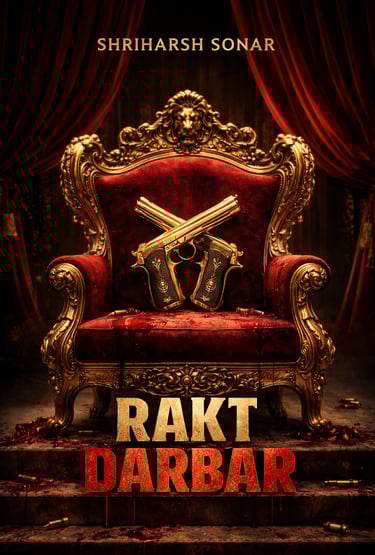
Rakt Triology - Rakt Darbar
Part I of the RAKT Trilogy
“Bina rakt, takht nahi milte.
Aur rakt-laal darbar, kaale itihaas bina nahi likhe jaate.”Overview
Series Overview
RAKT DARBAR is not a story about power gained.
It is a story about power that survives its own destruction.
From its opening frame, this series announces itself as a reckoning—not a continuation, not a nostalgia exercise, but the brutal afterlife of a kingdom that refused to die quietly. It begins with a single, unsettling question:
What if the last night of blood was not the end—but the beginning?
Ash drifts through a burning stronghold. Smoke coils around funeral flames. A rocket tears through ancestral walls—but strikes something far more fragile than brick and mortar. The throne is declared fallen. The rulers are declared dead.
They are wrong.
This is not a flashback.
This is the missing canon—the version of history that was buried because it was too inconvenient to tell.
The War for a Broken Throne
By the time the dust settles, the old kingdom is unrecognizable.
A man sits on a cracked throne amid ruins—crowned by force, starved of loyalty. His victories taste of ash. His authority is loud, but hollow. Beside him, a woman writes in a dead man’s diary by candlelight, discovering that vengeance offers no peace—only continuity.
Elsewhere, power recalibrates quietly.
A widow calculates over tea, sheltering a fugitive.
A strategist perfects a double lie—telling one prince the king is dead, telling the king the prince is gone.
A digital nerve center hums to life, crimes moving in code instead of bullets.
The kingdom no longer fights only in alleys and fields.
It fights in servers, courtrooms, press briefings, and encrypted rooms where empires are dismantled without a single shot fired.
Bloodlines, Business, and Betrayal
As the season unfolds, the battlefield widens.
Cash flows are frozen by state machinery.
Allies become liabilities overnight.
Public narratives are weaponized to turn kings into monsters.
The new underworld is colder, smarter, cleaner. Romance scams, crypto laundering, digital extortion—violence without visible blood. In contrast, the old guard bleeds in silence: a recovering patriarch watched over by herbs and ghosts; a paralyzed prince learning that survival is the cruelest teacher of all.
When truth finally surfaces—that the throne was paid for with innocent blood—the prince does not scream.
He learns to walk again.
Each step becomes a verdict.
Love as Leverage. Politics as War.
Midway through the series, the violence slows—just enough to cut deeper.
Love becomes currency.
Softness becomes strategy.
Desire is negotiated like territory.
Dinner tables replace firing ranges.
Sealed envelopes replace gunfire.
Glances destroy alliances faster than bullets ever could.
In one haunting sequence, the returning prince practices recovery—ten steps, ten memories, ten reasons to burn the kingdom down properly this time.
Not in rage.
In order.
The Return of the Prince
As the walls close in, prisons replace palaces.
The false king rots in isolation.
A sister disappears into the strategist’s orbit.
A silent matriarch stockpiles mercenaries and ancestral gold.
And then a voice echoes from the dark.
A sentence spoken once before.
Now spoken again—with consequence.
The nation listens.
The kingdom trembles.
The lie collapses.
The People’s Sabha
The convergence is inevitable.
All players arrive at one public square—politicians, criminals, heirs, survivors. Cameras roll. Silence tightens. Then the lights go out.
Gunfire.
Screams.
Blood pooling beneath symbols of democracy.
When order returns, it leaves behind bodies, executions, and a single truth spoken without a weapon:
“Rakt hi gaddi ka daam hai. Aaj bhi. Kal bhi.”
Blood is the price of the throne.
Always has been. Always will be.
The Curse of the Crown
By the final act, the kingdom feels cursed.
New political beasts enter the arena.
Triple-crosses bloom inside triple-crosses.
Crime mutates again—temples, jobs, donations, faith itself turned into revenue streams.
In a rain-soaked graveyard, a man digs with bare hands.
A prince sets the crown down instead of wearing it.
A strategist burns family photographs.
A queen signs a dead-man switch.
No one celebrates.
Because in this world, survival is not victory.
It is merely permission to continue bleeding.
RAKT Trilogy Vision
RAKT DARBAR is the first chapter of a larger saga—a trilogy that examines power not as ambition, but as inheritance.
• RAKT DARBAR — The throne is taken
• RAKT SANSKAR — The bloodline justifies itself
• RAKT ANTYA — The crown demands its final payment
This is not a story about heroes.
It is a story about systems that outlive them.
Final Truth
Power never asks who deserves it.
It only asks who is willing to pay.
And in the RAKT Trilogy…
The bill is always written in blood.