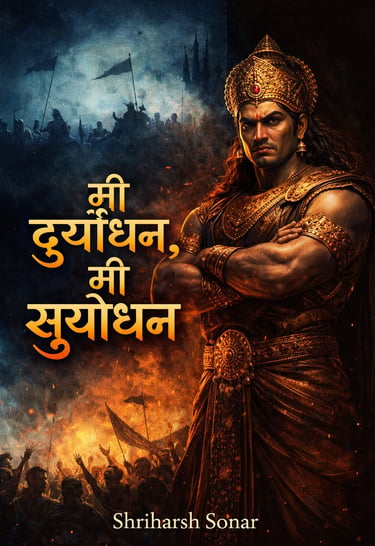
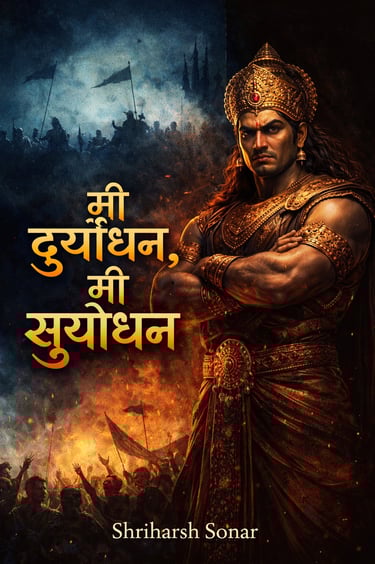
Mi Duryodhan, Mi Suyodhan
Concept Note
History remembers him as दुर्योधन.
This play listens to the voice of सुयोधन.
The Mahabharata is not merely a tale of victory and defeat.
It is a mirror held up to power, ego, inheritance, justice, and consequence.
And in that mirror stands a man history chose to condemn — often without pausing to understand.
This work does not ask whether Duryodhana was wrong.
That question has already been answered by time, war, and ashes.
Instead, it asks something far more unsettling:
At what moment does a rightful claim become unrighteous?
At what point does loyalty turn into blindness?
And when does strength begin to fear truth?
The Core Intention
This book — and its intended transformation into a Marathi stage play — seeks to enter the inner chamber of Duryodhana’s mind, where ambition, fear, pride, humiliation, and inheritance collided.
Here, he is not portrayed as a villain begging forgiveness.
Nor as a hero demanding sympathy.
He is portrayed as a man who believed.
Believed he was denied.
Believed he was mocked.
Believed he was protecting his lineage.
Believed power was his birthright.
Believed compromise was weakness.
And belief — when unexamined — is often more dangerous than hatred.
Why “मी सुयोधन”
The name सुयोधन means one who fights well.
Not one who fights justly — but one who fights with conviction.
This play recognizes that every antagonist sees himself as the protagonist of his own story.
On stage, मी सुयोधन is not a proclamation of innocence.
It is a confession of perspective.
The audience is not asked to agree with him.
They are asked to stand inside his mind long enough to understand how destruction often begins — not with cruelty, but with certainty.
The Draupadi Moment
The insult — “आंधळ्याचा मुलगा कायम आंधळाच” ("A blind man’s son will always be blind”)— is not treated here as justification, nor as provocation.
It is treated as a fracture.
A moment where humiliation, ego, inherited insecurity, and wounded pride sealed a path that could no longer turn back.
This play dares to acknowledge a difficult truth:
Words can wound as deeply as weapons —
but how one responds to that wound defines destiny.
A Play for Our Times
Though rooted in an epic, मी दुर्योधन, मी सुयोधन speaks unmistakably to the present.
To leaders who inherit power.
To systems that confuse entitlement with legitimacy.
To institutions that silence dissent instead of listening.
To individuals who mistake being right once for being right forever.
From kingdoms to corporations, from families to nations —
the tragedy repeats itself whenever power stops questioning itself.
What This Work Refuses to Do
It does not rewrite dharma.
It does not dilute responsibility.
It does not soften the consequence.
Kurukshetra still happens.
The fall is still inevitable.
Justice still stands.
What changes is only this:
We arrive at the fall with understanding — not slogans.
A Note on Form
This introduction is written with stage adaptation in mind.
The silences matter as much as the dialogues.
The pauses carry as much weight as the monologues.
This is a play meant not to entertain comfortably,
but to unsettle thoughtfully.
Closing Note
This is not a defense of Duryodhana.
It is an inquiry into how humans arrive at irreversible choices.
Because history is not destroyed by villains alone.
It is often undone by men who never believed they were wrong.
And that question —
“Where did I stop listening?” —
belongs not only to Duryodhana,
but to all of us.
A Question We Must Dare to Ask
The verdict of history remains unchanged.
Duryodhana’s choices led to the destruction of himself, his family, and his kingdom.
But before we close the book, this play asks one final, uncomfortable question:
How often do we echo his logic in our own lives — without calling it injustice?
When ancestral property is divided,
do we measure only blood or contribution?
When one sibling stays back to care for aging parents,
manage illness, tend land, protect livelihoods,
while another leaves for the city, builds a career, a lifestyle, and returns only to claim an equal share —
do we call the first fortunate, and the second entitled?
Or do we avoid the question altogether?
When effort is silent, and absence is convenient,
when responsibility is long-term, and reward is instant,
when sacrifice has no receipt — who decides what is fair?
This play does not answer these questions.
It does something harder.
It asks whether we are quick to name Duryodhana in history,
Yet slow to recognize his reasoning in ourselves.
The war still happens.
The fall still comes.
But before judging him,
The play invites us to ask:
If placed in his position today —
with land, lineage, pride, and fear —
Would we truly choose differently?
Opening Monologue
उद्घाटन एकपात्री प्रयोग : सुयोधन
(Opening Monologue: Suyodhana)
मी उभा आहे…
पण माझ्या भोवती कुणीच नाही.
माझ्या शेजारी इतिहास उभा आहे.
आणि इतिहास कधीच कुणाच्या बाजूने उभा राहत नाही.
(Pause)
माझं नाव घेतलं की,
लोक आधी निर्णय देतात…
आणि मग ऐकतात —
जर ऐकलंच तर.
पण आज…
आज मी काही सिद्ध करायला आलेलो नाही.
मी फक्त बोलायला आलो आहे.
आणि तुम्ही —
ऐकायला तयार असाल,
तर ऐका.
माझं नाव दुर्योधन आहे —
म्हणजे ज्याचं युद्ध चुकीचं ठरलं.
पण माझं दुसरं नाव आहे — सुयोधन.
ज्याचा अर्थ —
जो लढतो.
जो माघार घेत नाही.
मी जन्माला आलो तेव्हा
माझ्या हातात तलवार नव्हती…
माझ्या हातात होती फक्त ओळख.
कौरवांचा वारस.
हस्तिनापूरचा पुत्र.
आणि त्याचबरोबर —
भीती.
भीती ही कमजोरी नसते.
ती पहिला इशारा असते.
भीती सांगते —
काय गमावता येईल.
माझ्या भीतीचं नाव होतं —
हक्क.
जो माझा वाटत होता.
जो मला सांगितला गेला.
जो माझ्या रक्तात ओतला गेला.
माझ्या आयुष्यात एक प्रश्न कायम होता —
हक्क मागणं चुकीचं कधी होतं?
आणि त्यासाठी लढणं पाप कधी ठरतं?
कोणी मला शिकवलं नाही
की हक्क आणि अहंकार
यांच्यातली रेषा
इतकी पातळ असते.
मी अपमान विसरू शकलो नाही.
कारण तो अपमान नव्हता —
तो इशारा होता.
तो सांगत होता —
तुझ्या शक्तीवर हसणारे आहेत.
तुझ्या अस्तित्वाला आव्हान देणारे आहेत.
आणि त्या क्षणी…
मी ऐकलं नाही.
आज मला विचाराल —
तुला पश्चात्ताप आहे का?
(Pause)
पश्चात्ताप हा शेवटचा शब्द असतो.
माझी कथा तिथे संपत नाही.
माझी कथा तिथे सुरू होते
जिथे ऐकणं थांबतं
आणि खात्री सुरू होते.
मी सुयोधन आहे.
मी तुमच्याकडे माफी मागायला आलो नाही.
मी निर्दोष आहे असं सांगायला आलो नाही.
मी फक्त एक गोष्ट विचारायला आलो आहे —
जर तुम्ही माझ्या जागी असता…
तर तुम्ही वेगळं ऐकलं असतं का?
(Long pause. Lights dim.)
Director’s Note
This work is not an attempt to rehabilitate Duryodhana, nor to rewrite the moral arc of the Mahabharata. The outcome is known. The consequences are non-negotiable.
The intention is simpler — and harder.
To ask whether power, entitlement, and inheritance still confuse us today, just as they did then.
To examine how easily conviction slips into cruelty when left unquestioned.
And to remind ourselves that history’s villains were once people who believed they were right.
मी सुयोधन is not a verdict.
The Character is not asking you to forgive, but you to listen.
It is an invitation to reflection — before judgment becomes irreversible, and...
This play will examine the mind before the fall!
I stand here…
but there is no one beside me.
History stands next to me.
And history never stands on anyone’s side.
(Pause)
When people hear my name,
they pass judgment first…
and listen later —
if they listen at all.
But today…
today I have not come to prove anything.
I have only come to speak.
And if you are willing —
to listen —
then listen.
My name is Duryodhana —
the one whose war was judged wrong.
But I have another name — Suyodhana.
Which means —
one who fights.
One who does not retreat.
When I was born,
there was no sword in my hand…
only an identity.
Heir to the Kauravas.
Son of Hastinapura.
And along with that —
fear.
Fear is not weakness.
It is the first warning.
Fear tells you —
what can be lost.
The name of my fear was —
right.
The right I believed was mine.
The right I was told about.
The right poured into my blood.
There was one question that never left my life —
When does claiming a right become wrong?
And when does fighting for it become a sin?
No one taught me
that the line between right and ego
is
so thin.
I could not forget the insult.
Because it was not just humiliation —
it was a warning.
It told me —
there are those who mock your strength.
Those who challenge your existence.
And in that moment…
I did not listen.
If you ask me today —
Do you feel remorse?
(Pause)
Remorse is the final word.
My story does not end there.
My story begins
where listening stops
and certainty begins.
I am Suyodhana.
I have not come to ask for forgiveness.
I have not come to claim innocence.
I have come to ask only one thing —
If you were in my place…
would you have listened differently?
(Long pause. Lights dim.)