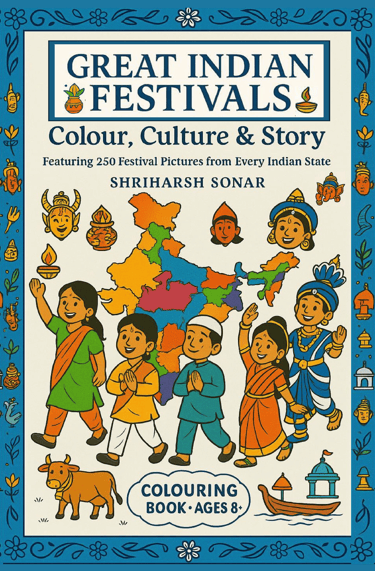
Great Indian Festivals
A Picture Colouring Book That Grows With a Child
Some books entertain children.
Some teach them.
And a very rare few quietly become part of who they grow up to be.
Great Indian Festivals is one such book.
At first glance, it looks like a colouring book—filled with joyful illustrations, bold outlines, and inviting spaces waiting to be brought alive with colour. But as soon as a child (or a parent) turns a few pages, something deeper begins to unfold.
This book takes young readers on a gentle, joyful journey across India’s living heritage, covering 250+ festivals celebrated across all 28 States and 8 Union Territories—from the high mountains of Ladakh to the coastal rhythms of Kerala, from tribal traditions to grand city celebrations. Every page represents a festival that people actually live, celebrate, and pass on—carefully chosen with no repetition, so that each turn of the page feels like discovering a new part of the country.
What makes this book special is not just what children colour—but what they absorb while colouring.
Each illustration is paired with a short, child-friendly explanation that quietly answers three important questions:
What is this festival? Why is it celebrated? What does it mean to the people who celebrate it?
The language is simple, warm, and conversational—meant to spark curiosity, not overwhelm.
Before exploring a state’s festivals, children are gently introduced to that region’s culture—its language, food, art, traditions, and identity—like a friendly guide preparing them for the journey ahead. Over time, the book begins to feel less like an activity book and more like a colourful cultural atlas made for young minds.
And then, there is a second layer—one that quietly sets this book apart.
Alongside India’s festivals, the book introduces Global Wisdom Capsules—short, thoughtful ideas drawn from 25+ countries across all continents. These are not lessons or lectures, but simple thoughts that reflect how children around the world are taught values like kindness, discipline, gratitude, respect, and hope. While children colour Indian traditions, they also encounter global ideals—learning, without effort, that the world may look different, but values often rhyme.
By the time a child reaches the final pages, something beautiful has happened.
They haven’t just coloured pictures.
They have travelled.
They have observed.
They have connected.
Great Indian Festivals becomes a book families return to—during festivals, during school projects, during quiet afternoons, and years later as a memory of childhood. It invites parents and grandparents to add their own stories, making every copy personal, lived-in, and unique.
This is not a book meant to be finished quickly.
It is meant to be grown into.
A celebration of colour.
A preservation of culture.
And a gentle reminder that understanding diversity early creates respect for life.
A Family Legacy Note
Great Indian Festivals is envisioned not only as a children’s book, but as a heritage guide, a family time capsule, and a gentle teacher of values. Beyond documenting India’s living festivals, the book intentionally appeals to parents and grandparents to record their own memories of celebrations, family rituals, local customs, and childhood moments. In doing so, each copy slowly transforms into a personal archive, carrying not just illustrated festivals but lived experiences passed from one generation to the next. As children colour, elders remember; as traditions are explained, family stories find a place to rest.
A Cultural Preservation Note
Great Indian Festivals is conceived as more than a children’s activity book—it is a sincere attempt to preserve the living cultural memory of India in a form that can travel gently across generations. India’s festivals carry within them history, ecology, food traditions, attire, music, rituals, community bonds, and collective joy. When these festivals fade from everyday awareness, culture itself begins to thin. By documenting over 250 festivals across all States and Union Territories—covering national, regional, tribal, rural, coastal, and hill traditions—this book aspires to quietly safeguard that continuity. Designed as a durable, library-worthy volume, it is offered with deep respect for our great Mother India, in the belief that cultural pride need not be taught through instruction, but can grow naturally when children see, colour, remember, and return to their roots. This work is placed on record with love for the country that shaped us, and with hope that today’s children will carry forward its diversity with understanding, dignity, and pride.